


MIG, MAG and TIG Welding: Differences and Applications
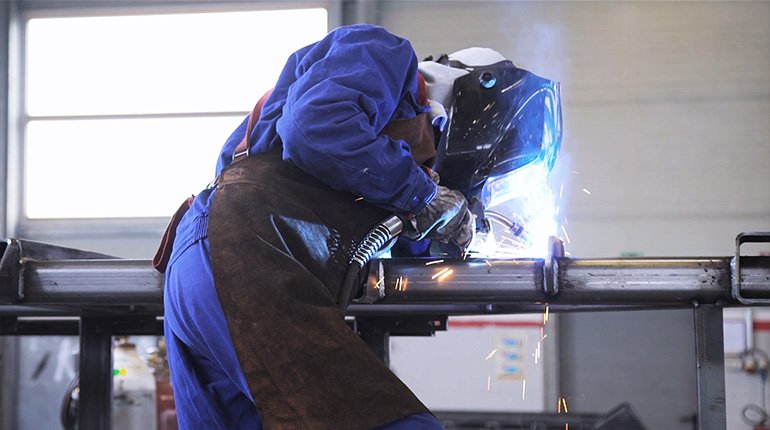
Shielded gas welding is one of the most commonly used methods of joining metals in industry and workshops. Among the most widely used processes are MIG, MAG and TIG welding, which enable high-quality and durable welds on a wide range of materials. Although these processes are often mentioned together and appear very similar at first glance – especially MIG and MAG – there are important technical differences between them that affect the welding process and the final application.
In this article, we will discuss MIG, MAG and TIG welding separately, clearly explain how each process works and highlight their advantages and limitations. Finally, we will compare them to make the selection of the appropriate welding process based on material, thickness and intended use easier, clearer and more technically sound.
MIG welding
MIG welding (Metal Inert Gas) is an arc welding process that uses a consumable wire as filler material and an inert shielding gas, most commonly argon or argon-based gas mixtures. The shielding gas protects the weld pool from the surrounding air, ensuring a stable arc and a clean, high-quality weld.
MIG welding is primarily used for materials that are sensitive to oxidation and require precise control of the welding process. Typical applications include aluminium, stainless steel as well as copper and its alloys. As a result, MIG welding is widely used in the production of lightweight structures, tanks, pipes and visually demanding welds.
Advantages & disadvantages of MIG welding
| Advantages | Disadvantages |
|---|---|
| clean and aesthetically pleasing welds | less suitable for structural steels |
| low spatter during welding | more expensive shielding gases |
| good control of the weld pool | higher equipment costs compared to MAG |
| suitable for thin materials | less economical for mass production |
- More about MIG welding: https://www.kovinc.com/wiki/mig-welding
MAG welding
MAG welding (Metal Active Gas) is an arc welding process that uses a consumable wire as filler material and an active shielding gas, most commonly CO₂ or mixtures of argon with carbon dioxide or oxygen. The active gas influences arc stability and weld penetration depth, resulting in reliable and mechanically strong welds.
MAG welding is mainly used for structural steels and due to its speed and cost effectiveness is one of the most widely used welding processes in industry. It is commonly applied in the production of steel structures, frames, beams, machinery and mass production, where productivity and repeatability of welds are essential.
Advantages & disadvantages of MAG welding
| Advantages | Disadvantages |
|---|---|
| high welding speed | more spatter than MIG welding |
| deep weld penetration | less aesthetic weld appearance |
| suitable for thicker materials | less suitable for non-ferrous metals |
| cost-effective process | higher thermal load on the material |
| widely used in industry |
- More about MAG welding: https://www.kovinc.com/wiki/mag-welding
TIG welding
TIG welding (Tungsten Inert Gas) is an arc welding process that uses a non-consumable tungsten electrode while the filler material is added manually when required. The weld pool is protected from atmospheric contamination by an inert shielding gas, most commonly argon, allowing for exceptionally clean and precise welds.
TIG welding is primarily used where high weld quality and precise process control are critical. It is often applied to stainless steel, aluminium, thin-walled pipes and demanding or visible welds, where appearance and reliability outweigh welding speed.
Advantages & disadvantages of TIG welding
| Advantages | Disadvantages |
|---|---|
| very high-quality and clean welds | slower process |
| no spatter | more difficult to learn |
| excellent control of the weld pool | less suitable for mass production |
| suitable for very thin materials | higher time consumption |
| aesthetically refined welds |
- More about TIG welding: https://www.kovinc.com/wiki/tig-welding
How to choose the right welding process?
The choice of the appropriate welding process mainly depends on the type of material, thickness, required weld quality and intended application. Each process has its own advantages so there is no universal solution – the key is to adapt the process to the specific task.
- MIG welding is an excellent choice for aluminium and stainless steel, where clean, aesthetic welds and good process control are required.
- MAG welding is best suited for structural steels and industrial production, where welding speed and cost efficiency are crucial.
- TIG welding is the ideal solution for precise and demanding applications, where weld quality, appearance and reliability outweigh slower welding speed.
Differences that determine weld quality
Although MIG, MAG and TIG welding are often mentioned together, they are different processes with distinct characteristics and applications. A good understanding of these differences enables the correct selection of the welding process, higher and more consistent weld quality and fewer errors and rework. At the same time, it increases efficiency in the workshop or production environment, as the process is better matched to the material and project requirements.
Choosing the right welding process is not only a technical decision but also has a significant impact on the durability, appearance and reliability of the final product as well as on costs and production time. For this reason, understanding the differences between individual processes is important for professional welders as well as for smaller workshops and occasional users.
At Kovinc d.o.o., we perform all three welding processes in accordance with prescribed quality standards. Based on your requirements and intended application, we are happy to advise you on selecting the most suitable process and ensure high-quality execution.
Send us your inquiry and together we will find the optimal solution.